Top 10 best supercars 2019


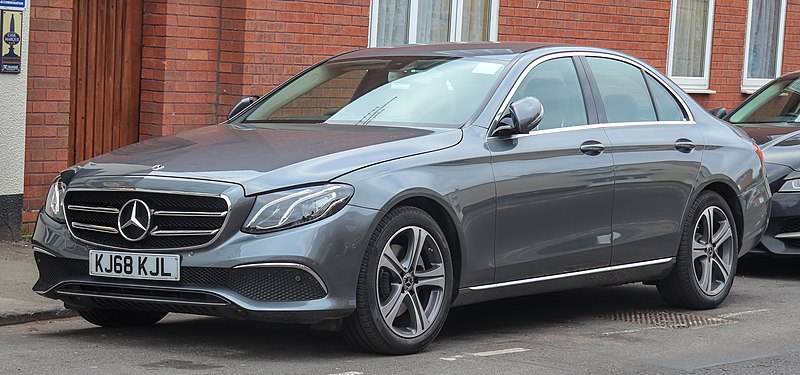
The Mercedes-Benz E-Class is a range of executive cars manufactured by German automaker Mercedes-Benz in various engine and body configurations. Produced since 1953, the E-Class falls midrange in the Mercedes line-up, and has been marketed worldwide across five generations.
Before 1993, the E in Mercedes-Benz nomenclature was a suffix following a vehicle's model number which stood for Einspritzmotor (German for fuel injection engine).
It began to appear in the early 1960s, when that feature began to be utilized broadly in the maker's product line, and not just in its upper tier luxury and sporting models. By the launch of the facelifted W124 in 1993 fuel-injection was ubiquitous in Mercedes engines, and the E was adopted as a prefix (i.e., E 220) and the model line referred to officially as the E-Class (or E-Klasse).
The definition of a supercar may have
changed over the past two decades, but that fact hardly makes the metal
content that makes up this class any less sensational.
Here, it’s the world’s greatest
mid-engined, upper-level performance machines we’re celebrating: not the
very highest echelon of the performance car market, but rather the kind
of cars you think about when you The definition of a supercar may have
changed over the past two decades, but that fact hardly makes the metal
content that makes up this class any less sensational.
Here, it’s the world’s greatest
mid-engined, upper-level performance machines we’re celebrating: not the
very highest echelon of the performance car market, but rather the kind
of cars you think about when you picture a modern Ferrari, McLaren or
Lamborghini.
Topping this class means demonstrating
that your designers and engineers can master an inherently tricky
dynamic brief, stand the heat of particularly intense competition, and
satisfy some of the most demanding customers in motordom.
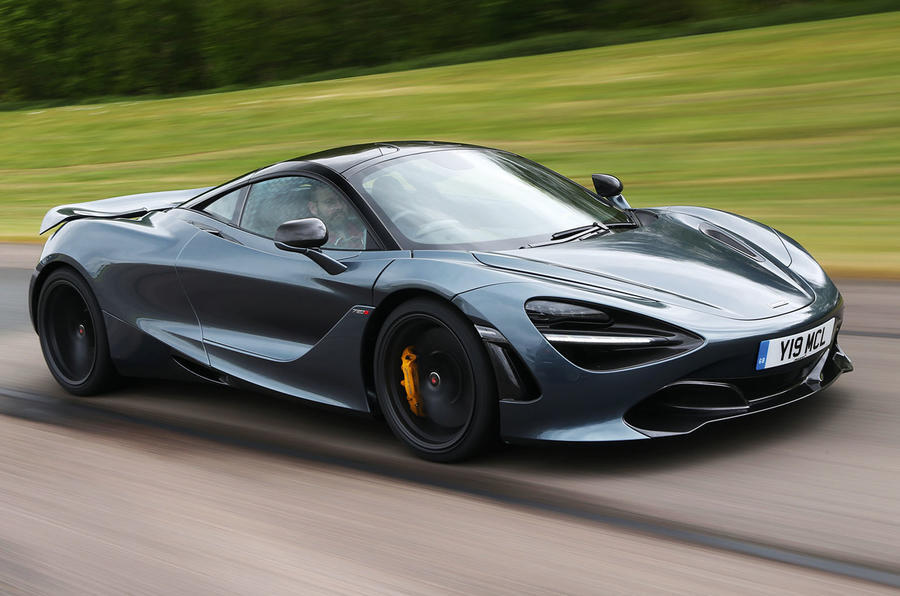
1. McLaren 720S
The McLaren 720S has succeeded where
both of its predecessors (650S and MP4-12C) fell short in our supercar
class chart: purely and simply, by topping it.
There are few more direct or effective
ways for cars in this stratum of the performance car market to
demonstrate their superiority than by accelerating faster, lapping
quicker and stopping harder than any rival: the 720S does all three. In
many of the performance benchmarks road testers are used to measuring,
in fact, this 710bhp blockbuster is a closer match for a contemporary
hypercar than one of its mid-engined opponents.
But it’s also uncommonly communicative
and easy to drive; is a supreme ergonomic achievement; and flatters a
rambunctious track style
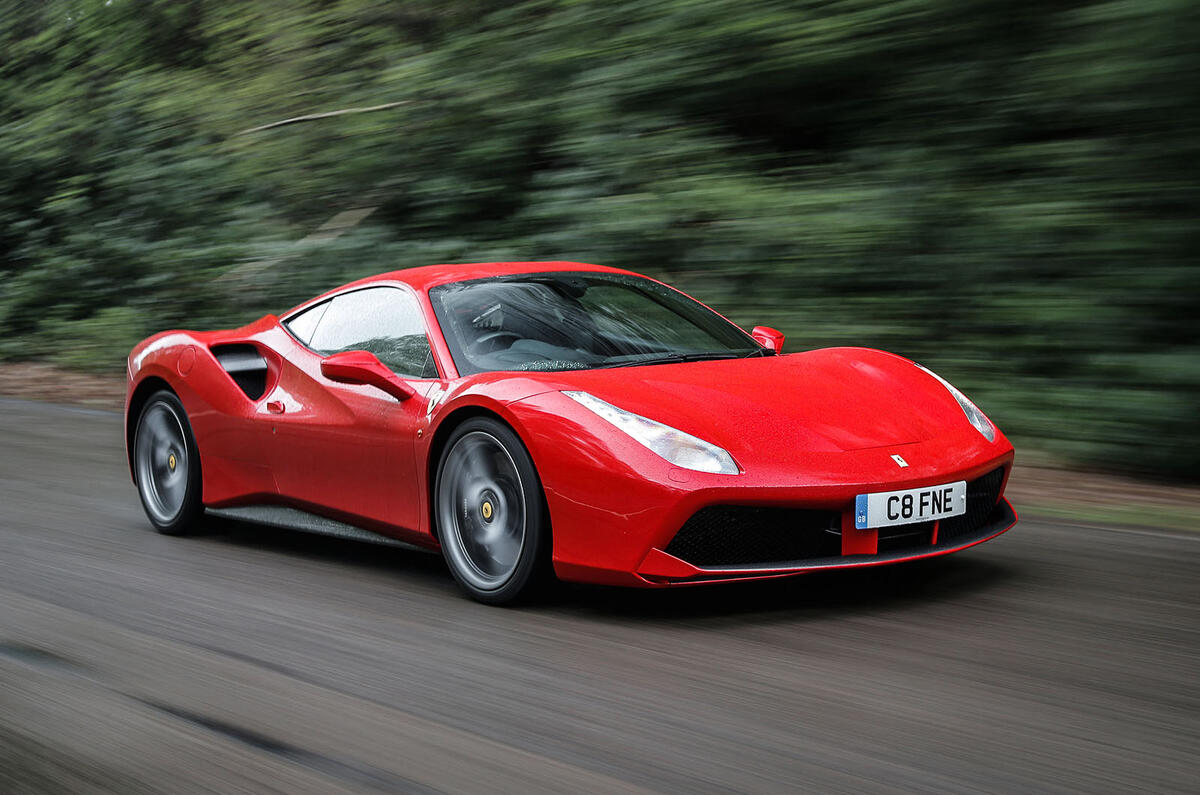
Ferrari 488 GTB review
We have entered the fifth decade of the mid-engined V8 Ferrari.
In 1975 Maranello replaced the V6 Dino
with the 252bhp 308 GTB; last year, at its Geneva show press conference,
it unveiled the seventh descendant of that line: the 661bhp 488 GTB.
It is our reigning Britain’s Best
Driver’s Car champ in left-hand drive form, so we’ve written about it a
fair bit already, but only now comes the chance to judge the car in
right-hand drive form, on road, track and weighbridge and against our
tape measure and timing gear.
The build-up to the car’s launch was
dominated by one key technical change: a twin-turbo 3.9-litre V8 derived
from the one first used in the California two years earlier.
It makes for sizeable gains in peak
power and torque relative to the atmospheric V8 in the 458 Italia and
delivers the required improvement in fuel economy and reduced emissions.
The logic of the car’s nomenclature is
also new. The 488’s predecessors have flip-flopped between different
rationales for their numerical identities since departing from the one
that seemed to make the most sense: the first two digits of the name
representing engine size and the last the number of cylinders, hence
308, 328 and 348.
Ferrari departed from that logic with
the F355 but returned to it with the 458 Italia. And now it has departed
once more, choosing ‘unitary displacement’ (or volume of one cylinder)
to define a model name, as it once did with its V12 cars.
Perhaps this car should be called 398 GTB, with an extra character allowed somewhere to represent those turbos.
But Ferrari has rarely replaced one of
its cars with another of lesser apparent numerical ‘value’ and credited
its customers with the intelligence necessary to understand that less
may be more, as seems to be the case with this downsized 488.
Lamborghini Aventador SVJ review
As I write, a number of Lamborghini
Aventador SVJs are belting down the main straight at Estoril race track,
a few yards from me, and the noise is more race meeting than track day.
That’s rare in the world of production
cars, to the extent that there’s a ‘last of the interceptors’ feel about
the Aventador, with its big mid-mounted naturally aspirated V12 and all
of the promise and compromise such an engine brings.
Sure, Ferrari still makes a naturally
aspirated V12, as will Aston Martin for a short while, but neither in
quite the same setting as this. There’s a difference between a super-GT
car and this, a super-sports car, a supercar of the original sense,
partly figuratively
, but also literally: an Aventador’s
mid-mounted engine breathes through a much shorter exhaust than a
front-engined GT, so its bark is louder. It’s a fact that means a car
like this will never be ‘so what’.
It’s important to remember that, I
think; whatever else you think about modern Lamborghinis and the way
they’re used. Only 5% of Aventador buyers will regularly show their car a
race track.
Pity. Because if owners did, they’d
really feel how fast it was, rather than just know it set a 6min
44.97sec lap of the… well, you know where.
It does that by being more powerful,
lighter, more aerodynamically clever, dynamically tweaked and having
more grippy tyres than before. The full engineering gamut, then.
What gives the Aventador SVJ its performance credentials?
Let’s start with the engine. The 6.5-litre V12 has titanium inlet valves,
a lighter flywheel, less internal
friction, an 8700rpm limiter and now makes 759bhp at 8500rpm. More
important, though, peak torque was at 5500rpm on the Aventador SV but
then tailed away rapidly;
the SVJ makes more torque through the
entire rev range before and including 5500rpm but its 531lb ft peak
doesn’t arrive until 6750rpm and its curve is flatter after that; so
considerably more torque reaches the wheels all the time.
Those wheels are lighter, as are several
other body components, so this (dry) is a 1525kg car, although given a
fuelled Huracán Performante was 200kg more than its claimed dry weight
when we put it on our scales last year, you can imagine where this will
end up.
Chassis changes see springs unchanged
but dampers and anti-roll bars stiffer, and the torque split typically
3% more biased to the rear; although it varies anyway. The front is
disconnected entirely during braking, to mean the only steering wheel
inputs are from braking, and there’s active rear-steer.
Then there’s the improved aero, which
brings the SVJ 40% more downforce than an Aventador S but,
significantly, is a second-generation ‘ALA’ (Aerodinamica Lamborghini
Attiva 2.0), which can push turbulent air out beneath the rear spoiler,
to stall it, reducing downforce and drag,
and which it can split from left to
right. In cornering, then, the SVJ will make more downforce on the
inside of the bend, which keeps the body flatter and helps turn-in.
Overall lateral g isn’t necessarily increased (you’d just put a massive
wing on if you
wanted to do that), but it apparently
means less lock is required to get into a turn, and given less applied
lock, more power can be applied, making corner exit quicker. I don’t
think it makes a lot of difference to an overall lap time: between one
and three seconds around a near seven-minute lap, according to an
engineer.
Making a bigger difference is the
option, for the first time, of race-derived Pirelli P Zero Trofeo tyres,
rather than Corsas, as on other Aventadors. It’s the first time the
Aventador has been offered on this rubber, which alone is worth around
10 seconds on a long lap.
The SVJ is limited to 900 units, and costs £360,000.
Understanding the SVJ's engineering
Would it surprise you to learn that the
SVJ was extremely fast? Thought not. J is for article J in the old FIA
documents that told car makers what they had to do to go sports car
racing, and although the Aventador doesn’t race, there are slower cars
that do.
Top 10 best affordable sports cars
Never has the choice of sports cars at
the affordable end of the spectrum been greater, each offering thrills
to match, and in some cases exceed, more expensive peers.
It's not all about brake horsepower at
this end of the market: most of the cars in our top 10 list put driving
bliss ahead of raw, straight-out performance. But we guarantee each will
put a huge smile on your face.
1. Alpine A110
Every significant component part of the
Alpine A110 driving experience – from the rasping turbocharged torque of
its engine to the hilariously immersive poise and panache of its
handling – is all about the F word: fun. It brings to life journeys and
roads that rivals wouldn’t, and has handling for which your affection
can only grow as you explore it more closely.
2. Porsche 718 Cayman
Even with its new downsized
four-cylinder turbo petrol engine, the 718 Cayman is by some distance
the most complete sports coupé on sale – and easily talented enough in
the handling department to overcome slight misgivings about the way the
crank is now turned.
In the long-term, memory of its past
power source will eventually fade. The manifest and numerous qualities
of the 718 will not.
Anatomise the car and you won’t find too
many mechanical ingredients or areas you could genuinely call
exceptional; but put them all together and you can’t help but conclude
that the A110 is a much greater car – and achievement - than the sum of
its parts would suggest.
Rarely does a car come along so devoted
to driver involvement, and so singularly effective at it, even among
affordable sports cars; the last time was probably the Toyota GT86 in
2012, a car to which we also gave a five-star recommendation for its
supreme fitness to the purpose of sucking the marrow out of every mile.
The A110 is quicker, more agile, more effusive and ultimately even more
fun. It deserves no less of an ovation.
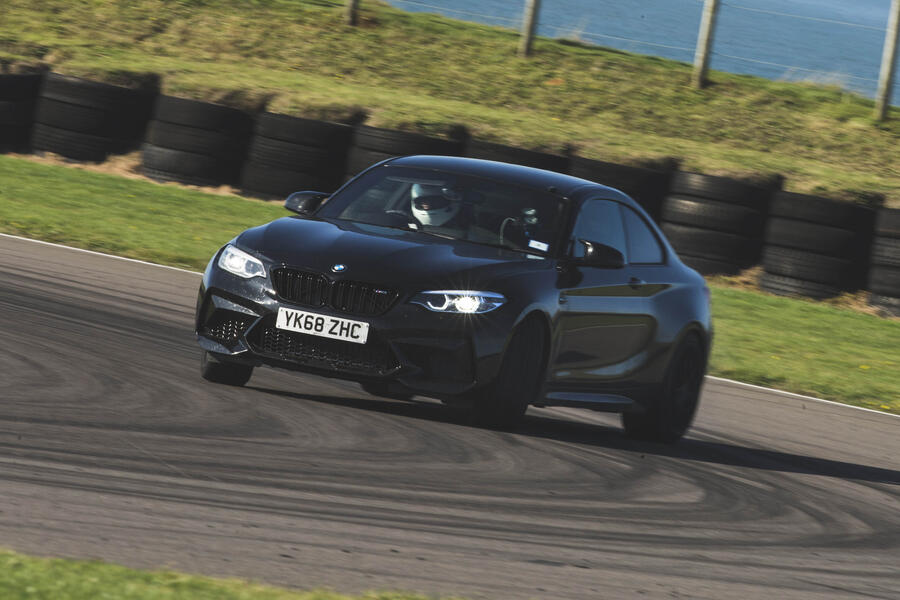
BMW M2 Competition 2018 UK review
What is it?
On the evidence of the launch event in
Spain, the BMW M2 Competition is the M2 we’ve been waiting for. The
original model, which you can no longer buy, was always a charming and
entertaining sports coupé, but anybody who drove one with any degree of
enthusiasm across a cresting or undulating road will know that it wasn't
blessed with brilliant body control. There were times when the M2 would
frighten the life out of you by apparently trying to unstick its rear
tyres from the road surface entirely whenever you popped up over the top
of a sharp brow.
It was a handling trait the larger M3
and M4 that arrived before it were similarly afflicted by, and the
reason why the M2 was never quite as rewarding to drive as a Porsche 718
Cayman S. Just as Competition and subsequently CS versions of the M3
and M4 were far better to drive than earlier models, the M2 Competition
is a huge step on from the M2.
For this most recent version, the M
Division has fitted a front strut brace, retuned the steering map and
dropped a handful of rose joints into the rear suspension in a bid to
make the car altogether more cohesive and responsive. The spring rates
and damper settings (now passive only) have been adjusted too.
Up front, meanwhile, the
twin-turbocharged straight six from the M3 and M4 replaces the old
single-turbo unit, although it has been detuned to 404bhp and 405lb ft
for this installation. The new motor contributes to a 55kg weight
increase, which means at 1625kg the M2 Competition is a good deal
heavier than its compact dimensions would have you believe.
What's it like?
Those revised suspension settings do
make for a tighter and more unyielding ride quality at low speed around
town, but in every other respect they are a huge step forward. Even on a
bumpier road at higher speed, there’s enough sophistication in the
damping of this car that the wheels can rise and fall individually over
the shape of the road without the body being skipped or jolted about.
The M2 Competition is so much more settled and composed than the M2 that
it feels like an entirely new car rather than an updated one.
Body control over crests and
undulations, meanwhile, has gone through the roof. No longer does it
feel as though the car might bounce itself clean off the Tarmac. The
steering is keener and more intuitive, too, all of which means you drive
along a winding road with a level of confidence that the M2 driver
could only dream of.
The old M2 strong points are still very
much in evidence, notably a sweet natural chassis balance that allows
you drive right up to the car’s limit of grip, as well as a transition
from neutral balance to power oversteer that’s as smooth as cream
pouring from a jug. The M2 Competition is every bit as happy being
driven neatly and with precision as it is playing the tyre-smoking
hooligan on circuit.
Combined with a high-quality cabin that
offers space for four, plus a more than useful boot, that wide operating
window makes the M2 Competition one of the most broadly capable
performance cars on sale at this price point today. It is far more
usable every day than a 718 Cayman S or an Alpine A110 without being
much less enjoyable to drive.
The M2 Competition would be a massive
step on from the M2 even if the old engine had been carried over
unchanged. The twin-turbo motor is more responsive in the lower reaches
and there is good energy towards the top end, but its soundtrack is more
monotonous and it doesn’t suddenly make the car feel much more
accelerative in a straight line. At least there is still a choice of
transmissions, our preference being the six-speed manual rather than the
seven-speed DCT
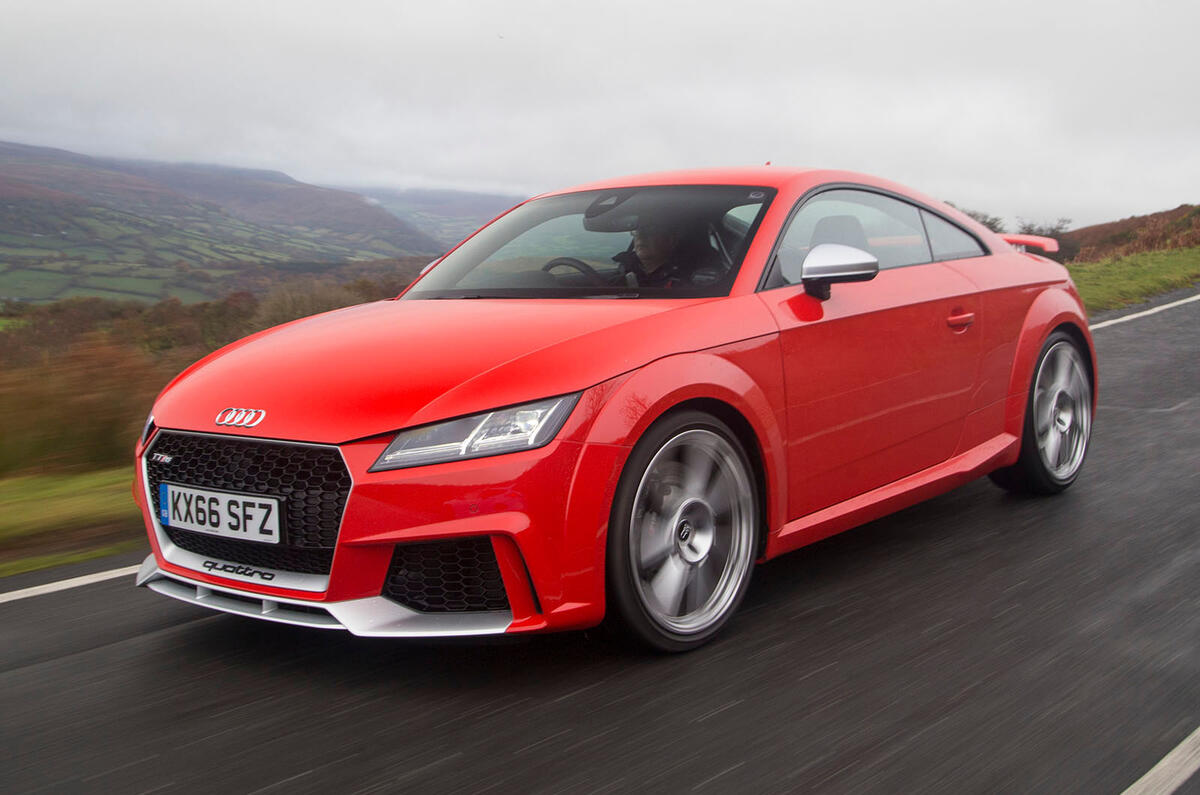
Audi TT RS review
The original Audi TT RS, launched in 2009, came with a big mechanical lure under its bonnet.
Ingolstadt hadn’t built a five-cylinder
engine since it retired the epic, Porsche-fettled 2.2-litre unit used in
the fondly remembered RS2 Avant.
Matt Saunders Autocar
Matt Saunders
Road test editor
Rear wing is fixed, so it doesn’t rise
at speed and can’t be taken to with a socket set for added downforce or
pose factor. Which is fine by us
But Audi instead referenced an even
bigger legend: the Ur-Quattro of the 1980s, a name custom-built to
generate a fizz in anyone old enough to recall the heroics of Group B
rallying – or young enough to have watched the highlights on YouTube.
The all-new 2.5-litre in-line five
cooked up for the TT lived up to the billing, producing 335bhp and the
kind of rasping, evocative soundtrack that fostered the idea of it being
a V10 split asunder.
Sadly, the car around it proved less
compelling – a symptom familiar to the TT and one not fixed when power
was increased to 355bhp for the Plus model in 2012.
Now the TT RS returns with a new
assurance based on the same strategy. Lightened and retuned to produce
394bhp, the engine in the car now delivers pace that merits comparison
with the supercar class by virtue of a 0-62mph time that drops below
four seconds – or so Audi says.
By making its TT RS coupé (and roadster,
for that matter) quicker out the blocks than a Porsche 911 Carrera 4S,
Ingolstadt has certainly laid down a technical marker. But glowing
praise in an Autocar road test needs to be earned by much more than raw
speed alone.
To secure that, Audi Sport needs to have
found the dynamic finesse and driver engagement that was so obviously
missing in the model’s last incarnation, and that’s a task typically
requiring time and money.
But with the Porsche 718 Cayman S now
hindered by a less than compelling engine, the prize at stake is
class-leading status in the sports car segment.
And what an unexpected kicker that would be.
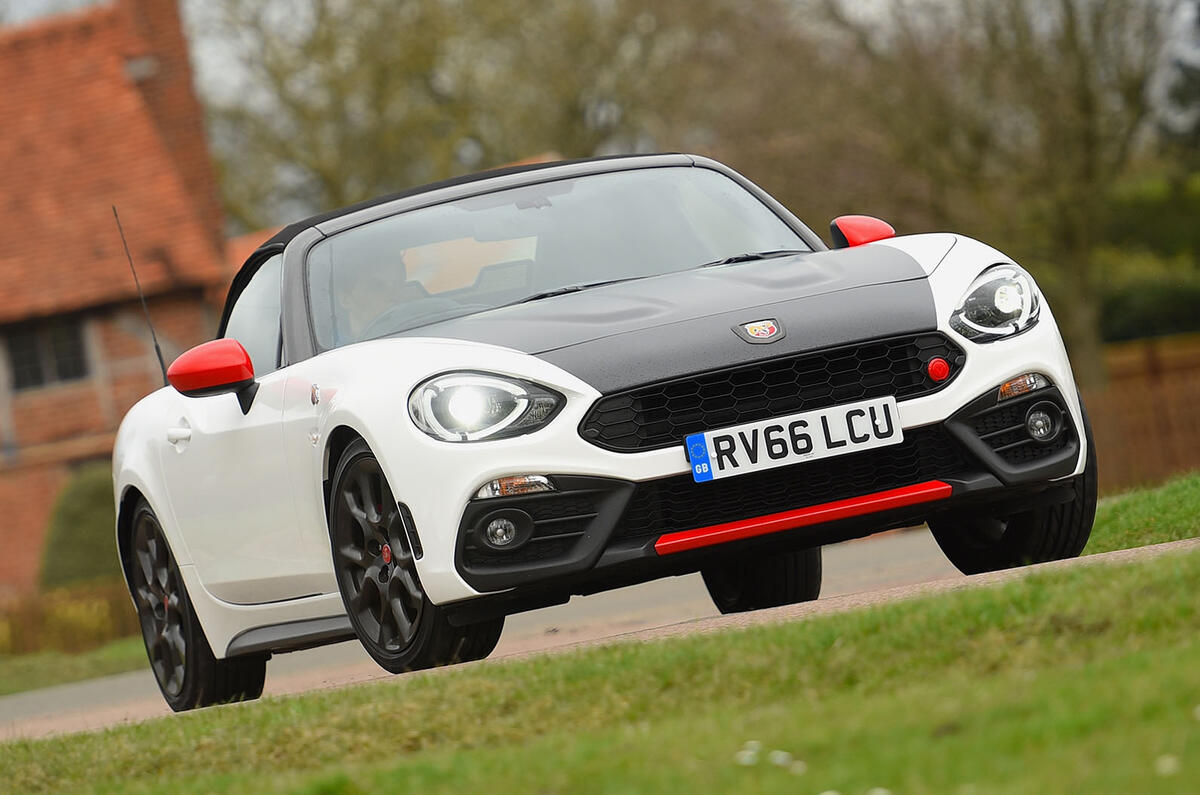
Abarth 124 Spider review
Last year we saluted Fiat for the canny
reasoning that resulted in the 124 Spider, its first rear-drive sports
car since the original model was discontinued in the early 1980s.
Although the amalgamation of Mazda MX-5
mechanicals and Italian styling was not a flawless integration by any
means, it delivered the kind of desirable product that was so obviously
missing from Fiat’s limited and conventional line-up.
However, to Abarth, Fiat’s feisty tuning
division, the 124 is of arguably much greater import. Where its parent,
through minimal investment of resource, gained a useful image bump
(particularly in the US) and a very decent roadster, Abarth gets the
chance to apply its underused talents to an already admirably talented
piece of kit – a dramatic shift from its current norm of uprating the
Fiat 500’s modest abilities.
The fact that there is also a manifest gap in the market for Abarth’s version does it no harm, either.
Mazda is famously conservative when it
comes to boosting the MX-5’s power, and although the Spider doesn’t
dramatically increase its established output, the 36lb ft of additional
peak torque (and a much greater dose of it at lower revs, of course)
supplied by the turbocharged 1.4-litre Multiair engine promises to be
significant in a car that weighs not much more than a tonne.
Furthermore, by returning the mechanical
limited-slip differential denied to the cooking versions of the 124
Spider, Abarth has been allowed to set out its stall.
This looks like an authentically
sporting sort of spider – and potentially the small Italian roadster
we’ve been waiting for since long before the misconceived Fiat Barchetta
was axed.
Certainly, it will need to be if Fiat is
to justify the asking price: starting at £29,565, the Abarth is almost
£6k pricier than a top-spec MX-5. Those are fancy, feelsome boots to
fill – but the pay-off ought to be the best scorpion-badge-wearer since
the Autobianchi A112 Abarth of the mid-1970s.
Mercedes-Benz E Class
The Mercedes-Benz E-Class is a range of executive cars manufactured by German automaker Mercedes-Benz in various engine and body configurations. Produced since 1953, the E-Class falls midrange in the Mercedes line-up, and has been marketed worldwide across five generations.
Before 1993, the E in Mercedes-Benz nomenclature was a suffix following a vehicle's model number which stood for Einspritzmotor (German for fuel injection engine).
It began to appear in the early 1960s, when that feature began to be utilized broadly in the maker's product line, and not just in its upper tier luxury and sporting models. By the launch of the facelifted W124 in 1993 fuel-injection was ubiquitous in Mercedes engines, and the E was adopted as a prefix (i.e., E 220) and the model line referred to officially as the E-Class (or E-Klasse).

No comments:
Post a Comment